Reduced effective scope
A wrapped chain is a shorter chain. Scope drops, the angle of pull steepens, and the anchor's holding power falls — sometimes well below safe.

Every mushroom anchor in a soft-bottom harbor will eventually have its chain wrapped around the stem. The only variables are when, and how bad. Here's why it happens — and what it costs.
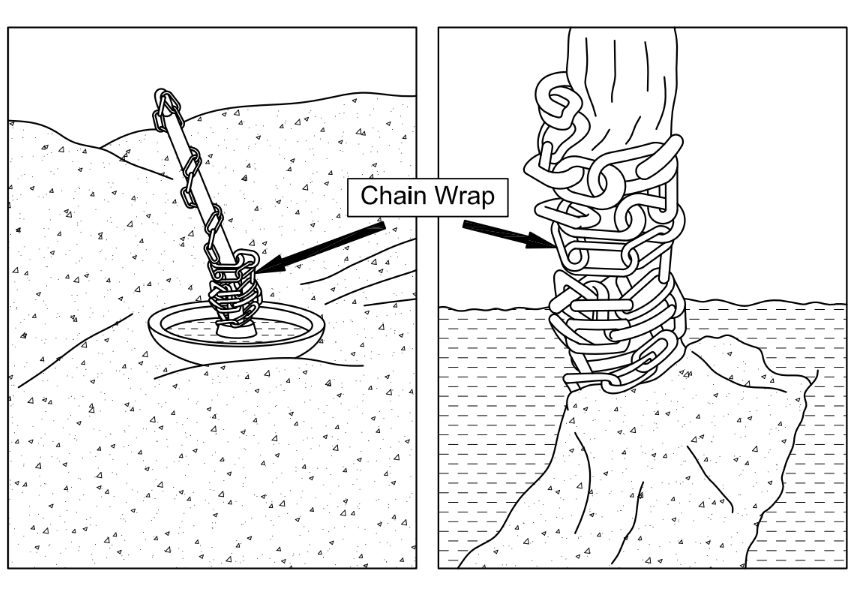
The mushroom anchor's bowl is genius. It sinks into mud and gains suction over weeks. But its vertical stem is the price of that genius — and the chain has to attach somewhere.
As tides come in and out, currents shift, and wind drags a moored boat through 360 degrees of motion, the chain rotates around the stem. Once it catches, every cycle pulls it tighter. What started as slack at low tide becomes a winch by morning.
Effective scope shrinks. Peak loads spike. Mooring balls get pulled under at high tide. Chain or shackle failure becomes a question of when, not if.
A wrapped chain is a shorter chain. Scope drops, the angle of pull steepens, and the anchor's holding power falls — sometimes well below safe.
The same wave action a properly-scoped mooring would absorb gets transferred straight to the chain, the shackle, the swivel, and the boat's cleat.
A wrapped, shortened chain at high tide drags the mooring ball below the surface. It's a visible warning sign — by then, you're already at risk.
Repeated overloading fatigues the metal. The failure point migrates upward — and the boat is no longer attached to anything.
It's never a convenient hour. Photos, reports, coordinating with insurance, with the owner, with neighboring boats — all because of geometry.
A boat that breaks free can grind on rocks, leak fuel, damage other vessels. The cost goes well past one mooring.
We didn't run our own tests on our own bench. We took the prototype to a Maine cordage facility for a tensile test, and into Casco Bay for a 28-day field test.
A horizontal tensile-strength test was conducted on a 100-foot test bed capable of generating up to 1.3 million pounds of force. A traditional 300 lb mushroom anchor and a 300 lb MoorSafe prototype were loaded in tension via shackles and rope loops until failure.
The MoorSafe prototype outperformed the traditional anchor by roughly 5% before failure. Different failure modes: the traditional fractured at the stem at 38,560 lb; MoorSafe's three hybrid stem joints dislocated at 40,657 lb.
Both anchors were set at the same location on a muddy seabed and left for 28 days to allow embedment and consolidation. Each was then connected to a 75-foot chain at 3:1 scope and tested with a lobster boat applying steady load. Tension measured with a 4,000 lb digital indicator.
A diver inspection found the traditional anchor partially buried with stem exposed; MoorSafe was fully buried in the mud. Breakout numbers were comparable — the traditional took slightly more force at 1,575 lb versus MoorSafe at 1,295 lb — but MoorSafe's deeper bedding suggests continued embedment improves over time.
Mushroom anchors have a vertical stem rising out of the bowl — that's where the chain attaches. As tides come in and out, currents shift, and a moored boat swings through 360 degrees of motion, the chain rotates around the stem. Once it catches, every cycle pulls it tighter. The geometry forces it.
Swivels and bridles help reduce twist in the chain itself, but they don't change the fact that the stem is still a vertical post the chain can wrap around. The wrap forms below the swivel, on the anchor side. The MoorSafe geometry is the only reliable fix because it removes the catch point entirely.
Serious enough to pull mooring balls under at high tide, fail shackles, and break boats free of their moorings. A wrapped chain effectively shortens, raising the angle of pull and the peak loads — often well past safe. In severe weather it's the failure mode that turns a routine mooring into an insurance claim.
The structural test was conducted at Yale Cordage's facility in Saco, Maine — a third-party rope and rigging test bed. The field breakout test was conducted in Casco Bay, Maine, with both anchors set on the same muddy seabed and pulled with the same lobster boat under the same conditions, with tension measured by a digital indicator and a diver inspecting both anchors before pull.
In the 28-day field test, the traditional anchor pulled at 1,575 lb while MoorSafe pulled at 1,295 lb. The difference is small and explained by burial depth — MoorSafe was fully embedded in mud, while the traditional was partially buried with its stem still exposed. A fully buried anchor's holding actually improves over time as more sediment consolidates above it. The traditional anchor's exposed stem suggests it had reached its maximum embedment.
MoorSafe doesn't reinvent the mushroom anchor — it removes the one flaw that's haunted it for a century. Tensile strength meets or exceeds the traditional design. Holding performance is comparable. Chain wrap, statistically and geometrically, no longer happens.
That's what we built. That's what we tested. That's what's coming to a harbor near you.